Other Names
Priest’s Crown, Swine’s Snout, Dudal, Herba Taraxaci, Lion’s Tooth, Pissenlit, Priest’s Crown, Pu Gong Ying, Swine Snout, Taraxaci herba.
Taste & Energetics
Bitter, salty, sweet, cold and dry.
Description & Harvesting
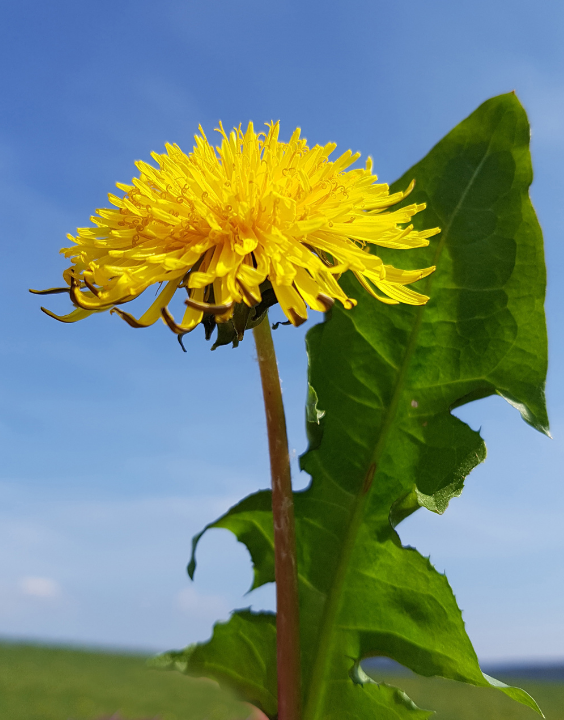
Familiar to most people, dandelion is a perennial herb with basal rosettes (15 – 22.5 cm long, 5 – 7.5 cm broad) with 5-6 teeth on a side and sessile. The flower head is compound, golden-yellow, and closes at night. It is native to Europe and has naturalized in North America. The young leaves are frequently used as a salad or greens. The whole plant, when broken or wounded, exudes awhite, bitter juice, the sensible qualities of which are said tobe greater during periods of inflorescence. Only the root is the official part, and should be collected while the plant is in flower, or preferably in autumn. When fresh, it is from 3 to 5inches or more in length, from 3 to 9 lines in diameter, tap-shaped, fleshy, dull-yellow or brownish externally, white internally, inodorous, and bitter.
History & Folklore
Arabian physicians used dandelion in the 10th-11th centuries. It was mentioned in Welsh herbals in the 13th century. It is prominent in Gerard’s Herbal (1597) and appears throughout herbals from the 16th to 18th centuries. Eclectics of the 1800s and the early 1900s also listed Dandelion as a major herb. This genus has been listed in Chinese medicine since the Tang Materia Medica (659 AD). It also has had a significant history of use in Ayurvedic medicine. Dandelion appears in the ethnobotanical literature of over a dozen Native American tribes, even as far afield as the Aleuts of Alaska. Its application is very broad but dermatological, analgesic and gastrointestinal problems seem to be prominent uses.
Medicinal Uses
Dandelion leaves have diuretic and saluretic action better than the root. They also deliver a good supply of potassium, useful with a diuretic. Dandelion root is known to be an excellent blood cleanser, specifically for the liver, as well as a mild laxative. The roots are slightly more diuretic when harvested in the spring and more for the liver when harvested in the fall. The latex has also been shown to be very effective for removing warts and is presently under study for its effects on eczema and psoriasis.The Chinese use the seeds as a strong antibiotic in the cases of lung infections. Dandelion is a slow, but excellent liver cleanser. It is not used for fast dramatic liver action, but as a constant slow liver cleanser. Drinking a cup of dandelion ‘coffee’ once a day for 1 – 12 months can do wonders for the liver. It will also tone up the hepatic structure, remove liver ‘stagnation’, improve digestion decongest the portal system and remove problems resulting from ‘heat’ rising to the skin. These cases develop slowly and can be best treated by moderate slow use of dandelion root. We can see these cases relatively easily by the mapped or geographic tongue. This has long been pointed out by the homeopaths. “Tongue covered with white film; feels raw; comes off in patches, leaving red, sensitive spots.” The tongue is usually red; indicating deep, internal heat. In Chinese medicine this indicates “phlegm fire” with the idea that heat has baked down fluids, which in turn thicken the fluid to block the escape of heat. This can be seen by bloating stagnant digestion, but also muscle and bone inflammation. Some have even shown that this can be the core cause of some forms of manic/depression. Dandelion also works on the lymphatic system, especially removing damp heat. The addition of cream of tartar to its decoction will render it more diuretic and laxative. When the stomach or bowels are irritable, it should not be employed. In Chinese medicine, it is considered one of the best remedies for reducing ‘liver fire’ and ‘fire poison’ (abscesses, boils, sores etc.). It is most often used for slow lingering heat, not fast hot heat. Michael Moore says it is specific for skin conditions, wheezy lungs, colon congestion and “leaky gut syndrome.”
Preparations & Dosage
Tincture: 1-2 mls, 2-3x/day
Capsules: 1-2, 2-3 times
Daily Infusion: 56g/L (1 cup/day)
Specific: Single drop fresh tincture
Homeopathic: 6x
Flower essence: 2 – 5 drop